Feed Mill Management Solution
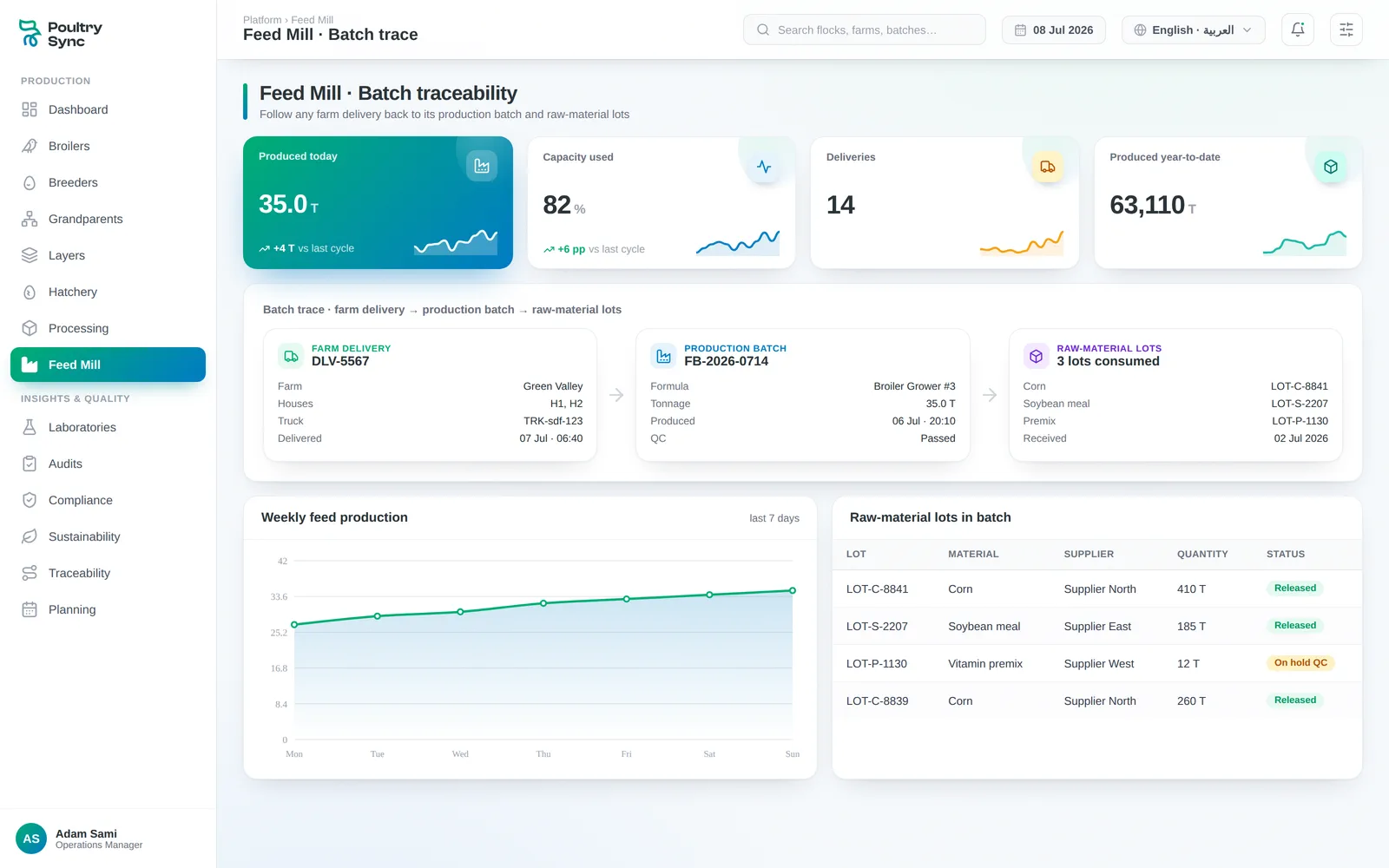
Run the mill as part of the value chain, not a silo: formulas, production batches, raw-material inventory, and deliveries that post straight to the farms consuming them.
What you manage
Formulas & versions
Ration formulations with full version history per feed type and species stage.
Production batches
Batch runs with actual vs. target inclusion, tied to formula versions.
Raw-material inventory
Receipts, suppliers, lots, and consumption — the input side of traceability.
Quality control
Raw-material and finished-feed sampling with results attached to lots and batches.
Deliveries to farm
Orders and deliveries posting directly into the receiving farm's feed record.
Cost per ton
Raw materials, milling, and logistics — cost per ton by feed type and formula.
Signature insight
From a farm silo back to a raw-material lot
When a flock stumbles, feed is the first suspect. Because deliveries link to production batches, and batches to formula versions and raw-material lots, the question 'what exactly did this house eat, and where did it come from?' is answered in minutes — with suppliers and lots identified.
Directly connected to
Frequently asked questions
Do feed deliveries really post to the farm automatically?
Yes — a delivery leaving the mill arrives as a feed receipt on the destination farm's record, with feed type, batch, and quantity. No re-entry, no reconciliation spreadsheets.
Can I trace a feed batch back to raw-material lots?
Every production batch records the raw-material lots it consumed, and every lot its supplier and receipt — so feed traceability runs both directions: farm to lot, and lot to every farm that received it.
How does the mill feed the sustainability numbers?
Feed composition and consumption are the largest part of poultry's footprint. Because the mill's data is already in the platform, the Sustainability module computes carbon per kilo from actual formulations — with no separate data collection.