
Poultry Planning & Optimization Solution
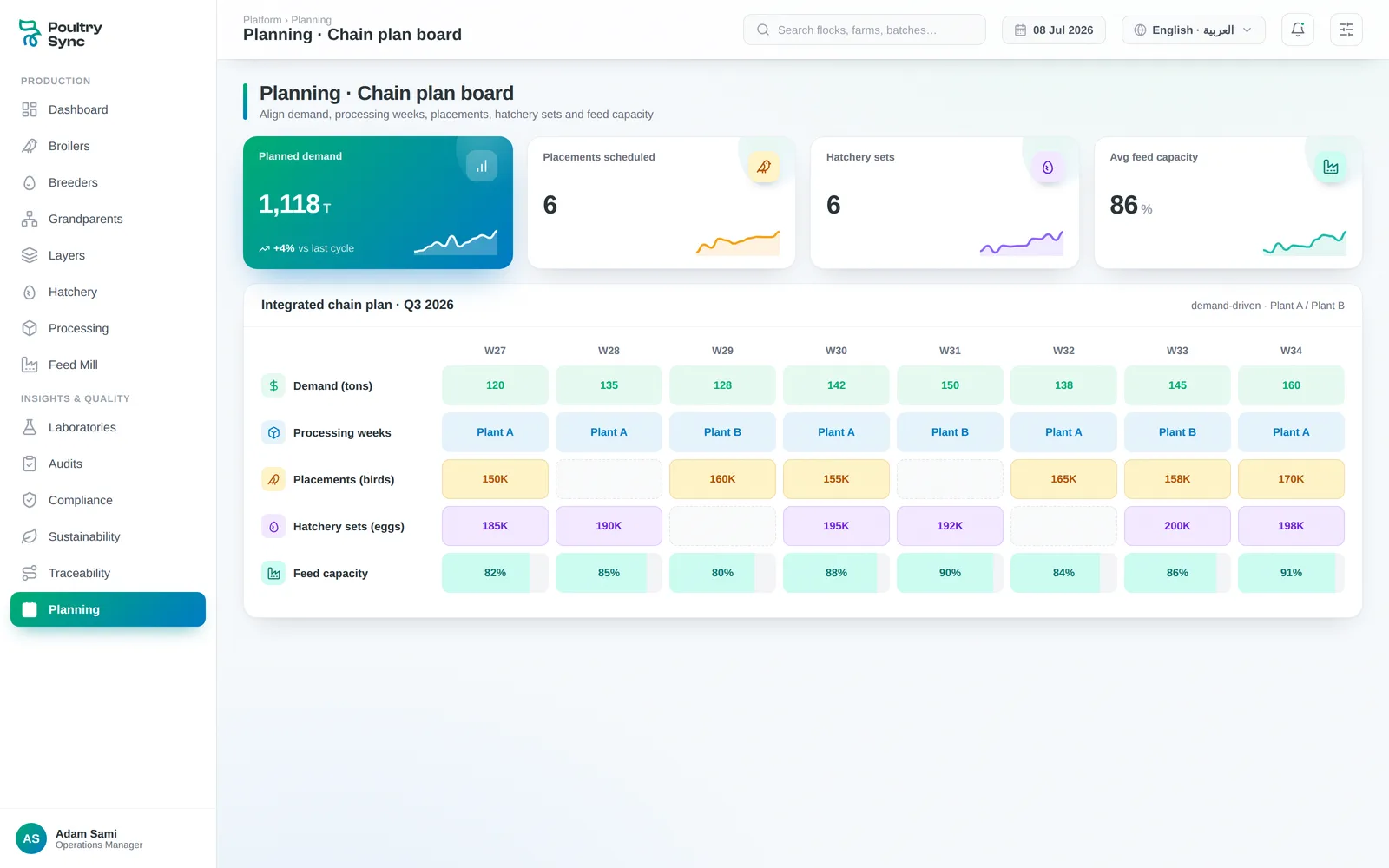
Plan the chain as one system. Whether you start from placements or from customer demand, the plan cascades through hatchery sets, farm capacity, feed production, and logistics — and stays consistent when reality moves.
A worked example
From a customer forecast to Tuesday's feed trucks
Demand comes in
A key account revises next quarter's volumes. The plan starts from what must leave the plant, week by week.
Plant weeks are set
Processing capacity allocates that demand into slaughter weeks and target live weights.
Placements are scheduled
Working back through cycle days, placements land on specific farms and houses.
Hatchery sets follow
Set plans derive from placements — and hatching-egg needs flow back to breeder flocks.
Feed demand cascades
Every placed flock projects its feed curve; mill production is booked by week and feed type.
…down to Tuesday's trucks
Deliveries schedule against farm silo capacity — the plan ends in how many feed trucks you need on Tuesday.
Signature insight
Forward or demand-driven — both directions, one plan
Some operations plan forward from breeder capacity; exporters and key-account suppliers plan backward from demand. The Planning module runs both against the same constraints — hatchery, houses, mill, trucks — so the argument about what is feasible happens in the plan, not on the phone.
Frequently asked questions
What constraints does the plan respect?
Hatchery set capacity, farm and house availability, cycle durations, mill production capacity, and delivery logistics — the plan is built against the chain's real bottlenecks, from your own records.
What happens when reality diverges from the plan?
Actuals stream in from the operational modules, so the plan shows its own drift — a light hatch or a slow flock surfaces as a downstream gap while there is still time to act.
Can I plan scenarios before committing?
Yes — alternative demand levels or placement strategies can be compared against the same capacity constraints before one becomes the working plan.